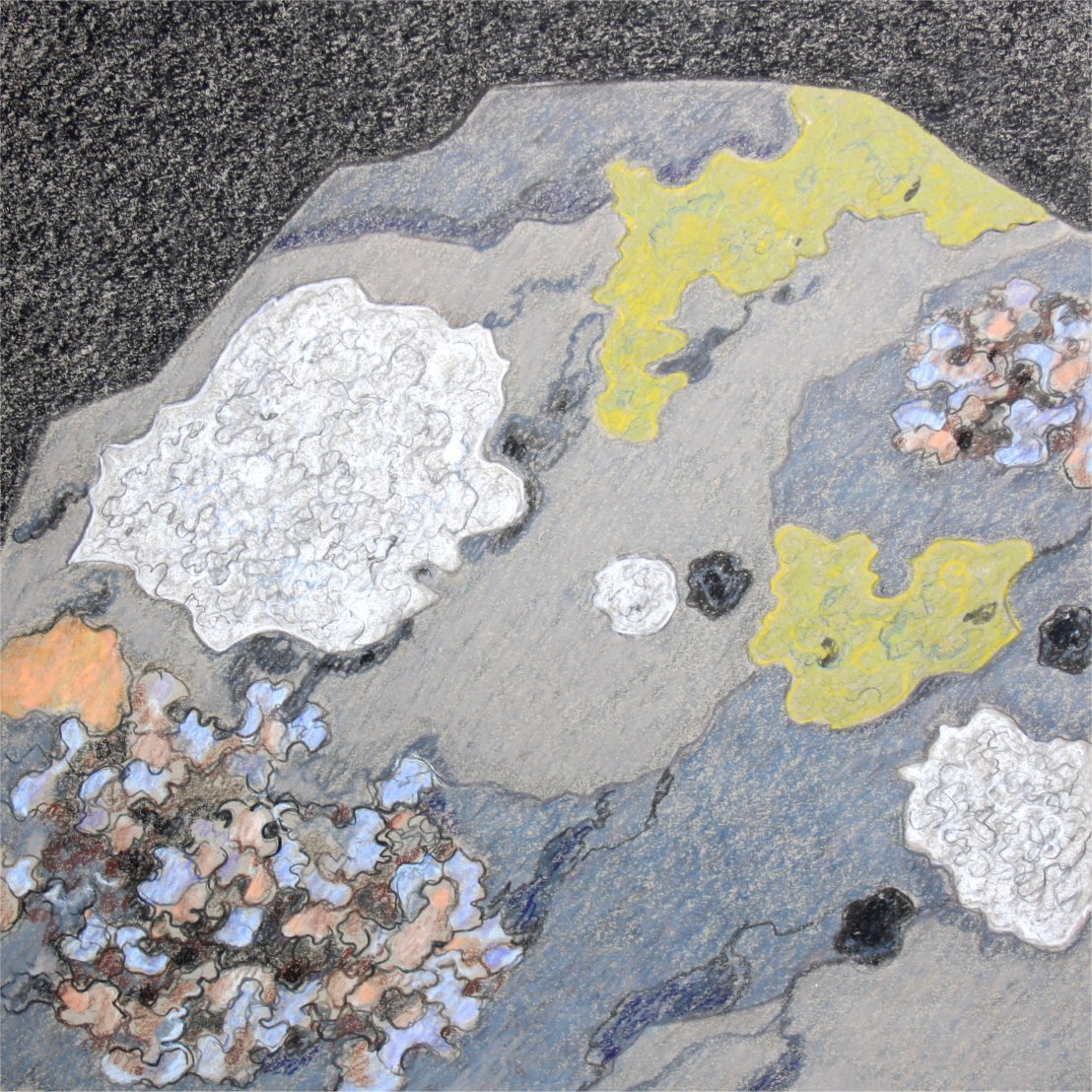
Learning to Pray…Again – a poem by Gloria Hefferman

Learning to Pray…Again

When I was a child
I prayed like a parrot,
a hatchling swallowing 
the food from its mother’s beak.

But I am not a parrot.
And if I were,
I wouldn’t spend my time
repeating everything I heard.
I would quietly preen
my emerald feathers and fly away 
to a rain forest in the mountains of Costa Rica
where I would hear only waterfalls 
and the raucous caw caw caw of my own kind.
And what sounds like random noises
would be my prayers uttered from a perch
high in the trees because I would be closer
to God’s ear there and wouldn’t have to squawk 
so loudly to be heard.

No, I am not a parrot.
And I am not a child.
And the prayers that spring to my lips
are not the words inscribed 
in the Baltimore Catechism,
or memorized in Sunday School
half a century ago.
But I trust God hears them.
So I kneel beside the bed once more 
and press my forehead 
to the cool sheet and beg,
Lord help us. 

Gloria Heffernan is the author of the poetry collection, What the Gratitude List Said to the Bucket List (New York Quarterly Books) and Exploring Poetry of Presence: A Companion Guide for Readers, Writers, and Workshop Facilitators (Back Porch Productions). Her work has appeared in over 100 journals including Chautauqua, Presence, Dappled Things, Braided Way, and Magma. She leads workshops on poetry as a spiritual practice.  

Make a Tree Good – a poem by Ryan Keating

Make a Tree Good

Make a tree good 
and its fruit will be good…
Matthew 12:33

I

I am tempted to staple a fig
To the branch from which is has fallen
Unburied brown in piles of failed fruit
That cover the shame of shallow roots
Turn the flat bruised side toward the trunk
Wipe it clean and shake off the tan worm
Paint it purple with faded green spots
Spray it with a fruit essence perfume
Keep it moist and sterile, sanitized
Step further back and admire the work
Because I am afraid I don’t know how
To make a tree good.

II

Sure, why not make it good
And make it well
Sink the roots deep 
And write the plot thick
Keep it secure
Commercial free
And incorruptible
Of shade but not dark
On a hill but not steep
Cured and decanted
Crispy
With soft contours
And clean lines
But free flowing
Fresh, fertile
Intricate, durable
Inspired in season
With lots of pockets?

That might be a harvest
Worth waiting for.

Ryan Keating is a pastor, writer, winemaker and coffee roaster on the Mediterranean island of Cyprus. His work can be found in publications such as Saint Katherine Review (forthcoming), Ekstasis Magazine, Agape Review, and Miras Dergi, where he is a regular contributor in English and Turkish.

Grace, defined – a poem by Caroline Liberatore

Grace, defined


i.

I am spineless, stiff-armed,
coveting guilt. I know
my own hands. They’re soaked

with ichor, viscous 
from attempted mercy.
Saccharine stain nauseating
in wake of a foreign economy.

My slitted sinew unravels.
          Oh, nods mercy, It will be hemmed. 


ii.

Slander slices a carving
knife into blood orange
and seeps. You peeled
instead of mourning,
citric carcass rested gently
on the sill. Wedge to lips, now
             take, sip the nectar.


iii.

Cross-examined, then consoled:
             We’ll have nothing more to do with that. 


Caroline Liberatore is a former English student and future librarian. She has also been published in Ashbelt Journal, Ekstasis Magazine, Foreshadow Magazine, and Clayjar Review. You can read more of her work at carolinelib.wordpress.com.

Natural Light – a poem by Jessamyn Rains

Natural Light

The crayons crumble inside their plastic bag
and a stick floats around the house, trapped inside

like a bug. The Tupperware is muddy,
the cardboard boxes soggy, and rocks

slide down the chute of a toy cement truck.
I feel like a drying-out drunk today, inside

a bloated laundry basket
with a headache, and my joints are bone

on bone, my brain a misfire
of thought and emotion. Natural light

fills the room through slats of a window blind,
alternating bars of dark and light,

and the picture on the wall is of a butterfly
stretching and drying its crumpled wings.

Jessamyn Rains is a writer, musician, and mother of four. She loves old books and new poetry. She lives with her family in East Tennessee. 

Guardians – a poem by Louise Mather

Guardians

Birds sing, 
butterflies watch on in, 
they don't know, 
they can fly away. 

Clouds swim calmly by, 
as sparks of heaven fall 
from the sky – 
raining white feathers 
to remind you. 

Louise Mather is a writer from Northern England and founding editor of Acropolis Journal. A finalist in the Streetcake Experimental Writing Prize, her work is published in various print and online literary journals. Her debut pamphlet The Dredging of Rituals is out with Alien Buddha Press, 2021. She writes about ancestry, motherhood, endometriosis, fatigue and mental health. Twitter @lm2020uk www.louisematheruk.wixsite.com/louisemather

Why I Go To Church – a poem by Kika Dorsey

Why I Go To Church


I dream of an ageless woman with short brown hair
and moist lips, body thin as young pine.

She has many children. She is a member of a religion
but none I know, not the one that caged me as a youth.

A preacher once said, “We are giving you a gift so that you
will be strong when you’re in pain,”

but I believed all was political,
and wine nothing like blood, bread nothing

like flesh that never crumbled. I believed
wings were made of nothing but skin, bone, and cartilage

and that only windows, not mirrors, don’t lie, that a brick
was nothing without mortar troweled by human hands.

I believed this: weather balloon, ambulance, furnace, dividends,
digging through the Earth’s magma to China and not a grave,

always culling, applauding, gathering, guarding,
and not the woman in the dream who visited me

in the middle of the night, lying on a bed,
surrounded by all her children chanting,

and I walk to her side and think how I only truly know
unconditional love when people die or are born,

my silence wrapped in prayer, a bell yoke,
a clapper swinging in a hollow mouth,

my children nothing like skin, bone, and cartilage,
nothing like windows or welded iron

but of gold, and when its sun lights the trodden path,
it is not despite the written hope of Earth, but because of it. 

Kika Dorsey is a poet and fiction writer in Boulder, Colorado.  Her books include the chapbook Beside Herself  (Flutter Press, 2010) and three full-length collections: RustComing Up for Air (Word Tech Editions, 2016, 2018), and Occupied: Vienna is a Broken Man and Daughter of Hunger (Pinyon Publishing, 2020), which won the Colorado Authors’ League Award for best poetry collection.

Investigating my Grief Group’s Reports of Communications from their Departed Ones – a poem by Karen Greenbaum-Maya

Investigating my Grief Group’s Reports 
of Communications from their Departed Ones

I strike my singing bowl, 
set it vibrating.
lean my ear inside with caution
so as not to interrupt.
I wait for the ringing to swell
and surround me,
for the sound to ring me, the way it does.
So dependable, how
the ringing goes on 
whether I attend or not
but softer	and softer.
I can never tell
if I hear the bowl
or the vibrations set up in my ear.
Is there still anything to hear? 
or is it no more
than memory of memory

Karen Greenbaum-Maya is a retired clinical psychologist, former German major and restaurant reviewer, and, two-time Pushcart and Best of the Net nominee. Her first full sentence was, “Look at the moon!” Her work has appeared in journals including Sow’s Ear Poetry Review, B O D Y, Comstock Poetry Review, Rappahannock Poetry Review, CHEST, and, Spillway. Kattywompus Press publishes Burrowing Song, Eggs Satori, and, Kafka’s Cat. Kelsay Books publishes The Book of Knots and their Untying. She co-curates Fourth Sundays, a poetry series in Claremont, California. She is currently working on a collection about her husband Walter, who died of lung cancer in 2018.

Welcome Mat – a poem by Peter Venable

Welcome Mat

She said a poem’s title
is a welcome mat,

where all visitors wipe clean
the world’s grime and gunk

from their trackless soles
and soul sludge. Gently knock . . .

when the front door opens,
who is she—silvery hair,

veiny hands—who
beckons you to enter?

Peter Venable has written sacred and secular verse for many decades. He has been published in Ancient Paths, Prairie Messenger, Time of Singing, American Vendantist, The Anglican Theological Review, The Christian Century, The Merton Seasonal, The Penwood Review, Ekstasis, Poems for Ephesians, The Windhover and forthcoming in Spiritus. His Jesus Through A Poet’s Lens is an eBook available at petervenable.com.

Born-Again Criminals – a poem by Rupert M. Loydell

Born-Again Criminals

'May my courage be greater than my fear 
and my strength as great as my faith'


Rio’s gangs of God blend faith and violence, Christ and cocaine. 
Drug lords, some regular churchgoers, with automatic rifles
have incorporated Christian symbols into their ultra-violent trade.

Rio’s narco-pentecostals admit their often brutal line of work,
including torture, murder and concealment of death,
clashes with the scripture they profess to follow.

A breathtaking evangelical tsunami has swept over society:
a new generation of evangelical gangsters on the frontline, 
rifle-toting extremists known as the Army of the Living God.

A warm breeze coursed through the narrow back alleys 
and for a moment the world seemed at peace –  
but shortly after midnight the crackle of gunfire woke residents:

another night of chaos and heartbreak in a city crying out to be saved.
Theirs is a cut-throat world so they seek something to believe in,
storm a nearby neighbourhood in hope of expanding their domain.

Evangelicals now occupy key positions in the world of crime, 
just as they once did in the media, politics, judiciary and culture;
a new generation of fundamentalist criminals take power.

Graffiti offers spiritual guidance and heavenly praise. 
Give thanks for blessings received from above; 
no one who believes should stay in darkness or unarmed.


     © Rupert M Loydell

Rupert Loydell is a writer, editor and abstract artist. His many books of poetry include Dear Mary (Shearsman, 2017) and The Return of the Man Who Has Everything (Shearsman 2015); and he has edited anthologies such as Yesterday’s Music Today (co-edited with Mike Ferguson, Knives Forks and Spoons Press 2014), and Troubles Swapped for Something Fresh: manifestos and unmanifestos (Salt, 2010)

Being Ruth Asawa – a poem by Anne Whitehouse

Being Ruth Asawa

“We do not always create ‘works of art,’ but rather experiments; 
it is not our ambition to fill museums: we are gathering experience.” 
— Josef Albers

“When I’m working on a problem, I never think about Beauty, I think only how to solve the problem. 
But when I have finished, if the solution is not beautiful, I know it is wrong.” 
— R. Buckminster Fuller

I remember sitting in the back
of my father’s horse-drawn leveler, 
dragging my big toe in the dirt path 
between fields, making looping, 
hourglass designs. This was in the 1930s, 
outside Los Angeles, California. 

My father leased land he couldn’t own
because of the law against foreigners.
My mother was a Japanese picture bride,
betrothed on the promise of a photograph. 
I was fourth of their seven children.

Our father built our house of board-and-batten, 
with a paper ceiling and a tin roof.
He knew how to use water wisely
and grew beautiful vegetables from that earth.

We toiled alongside our parents, 
planting, weeding, harvesting,  
nurturing the soil.
But our father was cheated at market.
We were so poor we salvaged 
nails from shipping crates.
We trapped gophers for meat.

Through persistence and perseverance,
our father increased his leasehold
to eighty acres. He hired laborers.
We owned two cars and two tractors.
He was a father to his brother’s five children
as well as to us, after his brother died.

After Pearl Harbor was bombed,
he made a big hole in the ground
where he buried our Kendo swords and gear.
He burned the beautiful Japanese books
on the tea ceremony and flower design
and the precious dolls and badminton paddles
my sister had brought from Japan
just months before.
One Sunday in February 1942,
two men in dark suits surprised us 
as we worked in the fields. 
They took our father by the arm
and marched him to the house.
They watched him eat lunch.
He finished his meal with a slice
of my sister’s lemon meringue pie,
and then they drove him away.

I learned later they were FBI
and suspected our father
of being a traitor.
He disappeared from our lives.
Four years passed before
we saw him again.

Soon, with thousands of others,
we were assigned to a detention camp
in Santa Anita. We lost almost everything
we owned. We lived in the stables
of a converted racetrack
surrounded by barbed wire.
Hair from the horses’ manes and tails
stuck between cracks in the walls.
In the summer heat, the smell 
of horses was overpowering. 

The excuse for separating us
from our homes and livelihoods
was that the U.S. was at war with Japan
where our parents were from.
Yet there was no similar removal 
of Italian or German Americans.

In the camp, I noticed three men 
who liked to sit together high
in the grandstand of the racetrack, 
balancing sketchpads on their knees,
drawing pictures with pieces of charcoal. 
They didn’t seem to mind the dust 
that blew up from the track, or the sun,
or if I sat with them. They encouraged me.
That was how I learned I was an artist, too. 

They were my teachers—
Tom Okamoto, Chris Ishii, James Tanaka—
Disney artists who’d drawn Pinocchio,
Fantasia, Dumbo, Donald Duck, 
and Mickey Mouse—now suspected
of being “enemies of the people.”

Yet I saw how when they worked,
worry fled. In the midst of hardship,
their concentration made a peaceful space 
where something unexpected 
and beautiful might happen.

Wire selected me,
not the other way around.
We had it on the farm,
and even as a child 
I noticed how useful it is
and how transparent a barrier. 

Wire starts out as a line, 
a boundary between two places,
inside and outside, left and right,
But wire can also be transformed 
into a three-dimensional object.

In the summer of 1947,
when I was an art student
at Black Mountain College,
I joined a public service project
to teach art to children in Toluca, Mexico.
In the market I noticed the wire baskets 
made by farmers to carry eggs and produce.
They needed no tools but their own hands.

They taught me how to wrap wire 
in even loops around a dowel.
Interlocking loops formed rows
which could be varied by size and shape
by adding loops or subtracting them.
It was like crocheting without a hook
or knitting without needles.

When I returned to Black Mountain,
my first sculptures were baskets
like the ones the Mexican farmers made.
When I joined the beginning to the end,
they became rounded, like fruits.
Next they stood up and took flight. 
They asked me to consider, 
what is inside, and what is outside?
I have spent my life finding out,
layering form within form,
voluptuous, swelling.
Was I thinking of motherhood,
of my own children? Yes, and no. 
Making art is a different mental process.
Any artist will understand.

My great teacher, Josef Albers 
taught the use of negative space,
beauty in repetition, and the cultivation
of a deep awareness.
He wasn’t interested in feelings.
If you want to express yourself,
do it on your own time, he said,
not in my class.

Some of the students resented this,
but I come from a culture
where personal feelings are hidden.

Albers said, Draw what you see,
not what you know.
Even black will change.
Never see anything in isolation.
Define an object by defining
the space around it.

I understood this, too.
As a child, I studied calligraphy
where we learned to consider the spaces 
between the brushstrokes
as well as the brushstrokes themselves.
 
Albers also said, Art doesn't know 
progress or graduation. Year after year
he taught the same courses—
design, color, drawing and painting,
presenting us with the same problems,
concepts, and assignments,
but each time was never the same.

I learned that nothing is ever settled 
in life or in art. Sometimes adversity 
yields an advantage. It’s like looking 
for a light in darkness.
Your eyes will sometimes betray you,
but eventually you’ll find a way out.
Our detention in Santa Anita was temporary. 
After five months, we were sent 
to the Rohwer Relocation Center 
in the swampland of southeast Arkansas,
where eight thousand Japanese immigrants
and Americans of Japanese descent
lived in communal barracks.

We shared lavatories, a laundry,
a kitchen, and dining hall.
The soil between the barracks
turned to black muck when it rained.
Cypress trees grow in the bayous,
and creeks snaked through fields
worked by sharecroppers.

The eerie beauty of that landscape,
half earth and half water,
has stayed with me,
the gnarled cypress knees
that grew straight up 
from their hidden roots 
through dark water.

We searched the swamps
for the most unusual shapes.
Sanded and hand-polished,
they became doorstops,
useful and ornamental.

My mother had brought seeds,
and we planted a garden.
We kept chickens and a pig.
At Rohwer, we went to school.
Every morning we pledged allegiance
to the flag of the United States of America.
When we came to the end,
“with liberty and justice for all,”
we added under our breath,
“except for us.”

Living with my family on the farm,
I had been an obedient Japanese girl.
At Rohwer, I learned to question authority.
Imprisoned as un-American,
I became American. Living the way
we did, without our father,
our family ties loosened. 
Students at Rohwer were allowed 
to attend college, if the college 
was in the middle of the country.
The Quakers provided assistance.
In 1943, my sister Lois left for Iowa.
Chiyo followed her. I was next.

I picked the Milwaukee State Teachers College,
because it was the cheapest
in the catalog. I boarded with a family 
as a live-in maid. Three years passed—
my father was released, the war ended, 
but I was told I couldn’t graduate. 
Because of my Japanese background,
no one would hire me as a teacher.

Before I left Rohwer for college, 
our teacher, Mrs. Beasley, told us
not to harbor any bitterness 
from what had been done to us.
It was wrong, but to dwell on it 
would only hurt us and hold us back. 

All I had strived for was destroyed
when I wasn’t allowed to graduate.
But what seemed the collapse 
of my hopes was the prelude 
to my transformation. 
There were two doors, 
and I opened both. They seemed
to lead down separate paths
but, in fact, they intersected.

In the summer of 1945,
my Milwaukee friends Elaine and Ray
wanted me to come with them 
to Black Mountain College 
in North Carolina,
but I went to Mexico City
with my sister Lois instead.
I studied design with Clara Porset,
a Cuban artist at the University of Mexico. 
Clara had also been to Black Mountain.
The next summer, I went there, too.

Some educational experiments
are destined to flower and fade.
Black Mountain College 
had a brief lifespan.
I was one of the lucky ones.

College life was like detention camp 
turned inside out. The college 
was also land-rich and dirt poor. 
We were encouraged to find ways
to do what we wanted 
with the few resources we had.
Teachers and students ate together, 
and everyone had to work. 
I gave haircuts to students and teachers,
worked in the school laundry,
and woke in the early morning 
to churn butter and make cheese.
How the Europeans loved soft butter 
and buttermilk at breakfast!

Many of the teachers were refugees.
Their culture made the college what it was.
Without the war, it would not have happened.
For a brief time, while it existed,
it was a haven for those who had suffered
because of their race, religion, or skin color.

My parents’ Buddhism consisted 
of rituals they never explained. 
At Black Mountain College,
we learned the precepts of Buddhism.
My studies gave me insight
into the religion of my ancestors.
There was harmony and affinity
between the principles of my college 
and the values of my heritage.

Rising before dawn
to make butter for breakfast,
I would knock on Albers’ door
to wake him on my way to the barn 
so he could photograph the fog
lying low over the mountains.
He would snap a few pictures
and go back to sleep.

When the cold fog 
from San Francisco Bay
comes rolling in 
through the big windows
of the high-ceilinged living room
of our brown shingled house 
on Castro Street, I sometimes 
remember the early morning 
mountain fog in North Carolina. 

At Black Mountain College,
I explored the land around me
as I had not done since childhood,
observing the trees and bushes,
vines and wildflowers. One day, 
after I’d been there a year,
I was walking on a forest path
when I felt someone’s eyes on me.
I turned and found myself
looking directly into his gaze.
It was Albert Lanier.
He had been watching me
before I noticed him.

Our backgrounds and upbringing
couldn’t have been more different,
yet we never had any doubts 
about our love for each other. 
We knew what we would be facing
as an interracial couple raising a family,
but Albert was an architect and builder 
and used to finding a way,
and I knew how to work hard. 
We weren’t likely to give up.

On a rainy summer day in 1948,
Albert and I watched from a ridge
with the rest of the college,
while our teacher, Buckminster Fuller,
connected the designated points
of a dome he had designed
out of strips of Venetian blinds.
When it failed to rise, he didn’t give up. 
The next summer he returned
with different solutions, 
and this time, the dome stayed up. 
There is no success without failure;
you succeed when you stop failing.

At Black Mountain College,
Albert built a Minimum House
with cheap industrial materials
and what was at hand. He diverted 
a creek to flow around the house.

The house took a year to complete.
There was a large room for living
and sleeping, a kitchen, a bath, 
and closets. Albert constructed a terrace 
of flat fieldstone and two walls 
of brown fieldstone striped with lichen
that he collected in the woods. 
I advised him how to place the stones
to make a pattern, side by side 
and up and down.

When Minimum House was finished,
Albert left to learn the building trades 
in San Francisco, where it was legal
for us to marry. I planned to join him 
in a year. Bucky Fuller designed 
our wedding ring as his gift to us—
a black Lake Huron stone in a setting
formed by three “As” for “Asawa.” 

I felt I needed to warn Albert
what it meant to marry me: 
My parents dare to be tolerant
because we have all suffered intolerance.
I no longer want to nurse such wounds.
I now want to wrap fingers
cut by aluminum shavings,
and hands scratched by wire.
Only these things produce tolerable pains.

You will have to look at me
on the streetcar or bus when you 
hear someone shout, ‘dirty Jap.’
I hope we never have to experience it,
but expect it, do not fear it.

I’ve overcome most of the fear.
This attitude has made me 
a citizen of the universe,
by which I grow infinitely smaller
than if I belonged to a family,
province, or race. I can allow myself 
not to be hurt by ugly remarks, 
because I no longer identify 
as a Japanese or American.


Our wedding took place two days 
after my arrival, on July 3, 1949, 
in a loft over the onion warehouse
that would be our first home.
I knew I wanted a large family. 
Josef and Anni Albers,
who were childless by choice,
were skeptical. Before Albert left 
Black Mountain, Albers took him aside 
and said, “Don’t ever let Ruth stop working.”

Albert’s work made mine possible.
We had six children in nine years:
Xavier, Aiko, Hudson, Adam,
Addie, and Paul. Raising children, 
growing a garden, and making art
were all connected for me.
I created my sculptures
with my children around me.
I wanted them to understand
that art does not have to be 
separate from the rest of life. 
It can be as ordinary 
and essential as breathing.

Bucky worked by trial and error,
Albers was interested in ideas
that didn’t have a shape yet.
My ideas come from nature.
I start with general principles
that apply to anything I do.
Instead of forcing a design
onto my material, 
I try to become background,
like a supportive parent 
who enables the child to express itself.

Each material has a quality of its own.
By combining it or putting it next 
to another material, I change it
or give it another personality, 
without destroying either one.
When I separate them again,
they return to what they are.
It’s the same with people.
You don’t change someone’s personality,
but combined with other people,
a person will take on different features.
The intent is not to alter,
but to bring out another aspect. 

A line can enclose space, 
while letting air remain air.
My wire sculptures
are a continuous surface.
I begin from the inside,
and as it takes shape, 
it comes out and in again
while remaining, essentially, itself.
What interests me 
are the proportions.

I folded origami as a child, 
but my folded sculptures 
come from my work with Albers.
We folded paper in the European way,
which is structural. 
We learned about the strength 
of certain angles.
You can fold a sheet of paper 
so you can stand on it,
as if it were made of wood.
With paper, you can easily change 
the folded angle, but metal is rigid.
You fold metal just once.

My friends Paul and Virginia
brought a desiccated plant
from Death Valley for me to draw.
The gnarled trunk branched off 
symmetrically, ending in feathery fronds.
To understand its structure,
I modeled it in wire, which led 
to my tied metal sculptures.

I start with as many as a thousand 
strands of wire in a single bundle. 
Using a pair of pliers
to cut and twist the wires,
I divide the bundle into thirds.
I continue to divide each branch
until only two strands are left.
I tie each joint with the same wire.
No solder is used.
When I create the tied center,
I have already made a decision.

It interests me to work out
variations of the same idea,
instead of following different ideas.
My sculptures are meant to be
suspended from the ceiling, 
mounted on a wall, or on a base.
Bronze wire stays green a long time.
Brass wire turns dark. Immersing it 
in an electrically charged sulfuric bath
leaves a greenish cast. The ends, 
dipped in resin, resemble raindrops.
I asked the plating company
to run the electric current backwards,
creating a rough surface.

One quiet Sunday morning,
scavenging for materials
on a San Francisco street,
I found coils of enameled copper wire
on a sidewalk outside a bar.
They came from the insides 
of smashed-up slot machines
that the city had recently outlawed
and ranged in color from rust-red
to purple and blue-back.

To be alert to my surroundings
is to be aware of opportunity.
When I was a child on the farm,
I shaped wire into rings and bracelets.
At Black Mountain we were encouraged
to use what we could find and was at hand.
When I worked in the college laundry,
I made drawings using the BMC stamp. 
Albers’ concept of the meander
influenced my studies of sequences,
patterns and contrasts, curves and reversals,
and optical illusions that “swindle the eye.” 

As the last rays of sunlight 
cast shadows across my living room, 
I sit cross-legged on the floor,
with the wire in my lap
and my hands on the wire,
my children around me,
reading or doing their homework,
playing or practicing the piano. 
Above us, my wire sculptures tremble 
and sway, in a dance with the air.
I feel they are protecting us,
like household gods.

I am often asked how I can bear
the tedium of my artistic process.
Farm work is by nature
tedious and repetitive,
and I grew up on a farm,
planting a thousand seeds at a time,
pulling hundreds of weeds,
harvesting fruit and vegetables
by the bushel. As I work,
I fall into a rhythm,
and the tedium becomes absorbing.

At Rohwer, I was proud of how well 
I strung my beans on the trellis I made,
working from the bottom to the middle 
to the top. I often construct 
my sculptures in the same way.

My process is about the cultivation 
of patience and stillness, 
of learning to be nonreactive
and sit with discomfort,
and it has made me a better wife,
daughter, mother, teacher, and friend.

I tell women who want to make art,
Don’t wait until it’s too late,
and you don’t have the energy.
You don’t need long stretches of time.
Learn how to use your small snatches of time
as they are given to you, and they will add up.

After the war, my parents never got back 
the leases they lost. They started over 
working for someone else in Arizona. 
They were simple people.
They wanted me to be lucky,
not in money or honors, but in life.

When I work, I am at one
with the spirit of my material.
Don’t be afraid of the unknown. 
The unknown is what will free you.

Anne Whitehouse is the author of six poetry collections Meteor Shower (2016) is her second collection from Dos Madres Press, following The Refrain in 2012. She is the author of a novel, Fall Love, as well as short stories, essays, features, and reviews. She was born and raised in Birmingham, Alabama, and lives in New York City. You can listen to her lecture, “Longfellow, Poe, and the Little Longfellow War” here.