Drop In A Waterfall


Who tells me
a drop in a waterfall
is not enough?
Must I shine like a sun
so my planets
can orbit around me?
Or be an angel at the top
of the tree?
What is so wrong about
being part of the flow,
one among many?
My sister brother droplets,
what is the ocean
but all of us finally together?
James Hannon is a psychotherapist in Massachusetts where he accompanies adolescents and adults recovering from disappointments, deceptions, and addictions. His poetry and non-fiction have appeared in journals including Amethyst Review, Blue River, Cold Mountain Review and in Gathered: ContemporaryQuaker Poets. His collection, TheYear I Learned The Backstroke,was published by Aldrich Press.
The Lord said, "Go out and stand on the mountain in the presence of the Lord, for the Lord is about to pass by." Then a great and powerful wind tore the mountains apart and shattered the rocks before the Lord, but the Lord was not in the wind. After the wind there was an earthquake, but the Lord was not in the earthquake. After the earthquake came a fire, but the Lord was not in the fire. And after the fire came a gentle whisper.
1 Kings 19:11-12 (NIV)Silence Heard on San Bernardino Peak
You will meet winds named the Santa Anas
on the trail to San Bernardino Peak.
Some say before the Spaniards came
the Serranos called them Satanas – Devil Winds.
They gather in the high desert, then vector
through passes bending limber pines and
leaving time-hewn boulders polished smooth,
a path of round-rock moraine strewn
from San Gorgonio’s crest down
to the trailhead, witness to power and glory
riding thunder and lighting, chasing clouds
back to the coast.
I went there, to the summit, as I was told
you can hear these winds and rocks speak
and I made my camp leeward of an outcropping
then waited and listened,
hoping for the voice of an archangel,
maybe Gabriel or Michael or one of the others,
but no one spoke, only the noise of wind,
but I am used to that, and besides,
if I were a chosen one, I am not certain
I could handle it – the weight of it all –
so I settled in for the night and watched
first stars appear above the San Andreas,
a crease that runs through these mountains,
and I thought about the myth of solid ground
while the wind grew louder and lights
from the valley began to flicker like embers.
I tried not to think about the earth
swallowing the mountainside, and I slept.
Sometime during the night the winds,
by whatever name, calmed and when I woke
all I heard was a whisper in the pines,
then silence so utter I was listening
to my own breath and all thought went the way
of a star racing across the heavens, falling
into hushed space.
James Green has published four chapbooks of poetry. His individual poems have appeared in literary magazines in Ireland, the UK, and the USA. Formerly a university professor and administrator, he is now retired and resides in Muncie, Indiana. You may contact him through his website at www.jamesgreenpoetry.net
Saint Joseph of Cupertino

One unexplained,
neither cogent nor lost,
a breeze wedged out of the glooms.
Of feather blood, hollow bone,
beaten brainless by seashore wings
soaring between light and mist,
an Easter bell pealing
a requiem to reason.
Throughout the day
he paddles clumsily,
soon billows like a sail
without keel or rudder
to hang onto
for lack of gravity.
He has few words for himself.
He blows smoke rings
from an insubstantial mind.

Never high enough go
the unanchored birds or
night’s orbed highways.
Rising on currents of sudden feeling,
he flies
along widening geodesics
of beatitude,
departing for good
from the confines of himself.
Stephanie V Sears is a French and American ethnologist (Doctorate EHESS, Paris 1993), free-lance journalist, essayist and poet whose poetry recently appeared in The Deronda Review, The Comstock Review, The Mystic Blue Review, The Big Windows Review, Indefinite Space, The Plum Tree Tavern, Literary Yard, Clementine Unbound, Anti Heroine Chic, DASH, The Dawn Treader, The Strange Travels of Svinhilde Wilson published by Adelaide Book 2020.
Summer at Poetry Camp of the Lord, with Petroglyphs


	Santa Fe, Summer 2019


The prickly pear must be prepared properly         Opuntia:

genus cactus.       Paddle nostle        thorns & the shape of a hand
we must use to carve our names into the rock,        the words

that form a poem hiding         in the ridge & cleft.
Eat the flesh        both sweet & strange        subtle

on our tongues & charred with the fire of inscrutable speech,
which each of us must interpret in a song        or prayer.

Magic, the way the wine loosens us to say
what we say in the shack        the black night,

how our mouths pause,       inhabit
the delicate cat-tail       the pine needles simmering
to a fragrant tea       & the unexpected meat

found on a trail. It’s hard to imagine all the animals
& plants we might eat.        Bodies breaking for us.

In the dark we proclaim each death until the sun
comes slowly behind the mountain in the morning,

illuminating each face as if it were our own.
Marci Rae Johnson works for Legible.com and as a freelance editor. Her poems appear in Image, The Christian Century, Relief, The Other Journal, Main Street Rag, Rhino, Quiddity, The Valparaiso Poetry Review, The Louisville Review, and 32 Poems, among others. Her most recent book was published by Steel Toe Books.
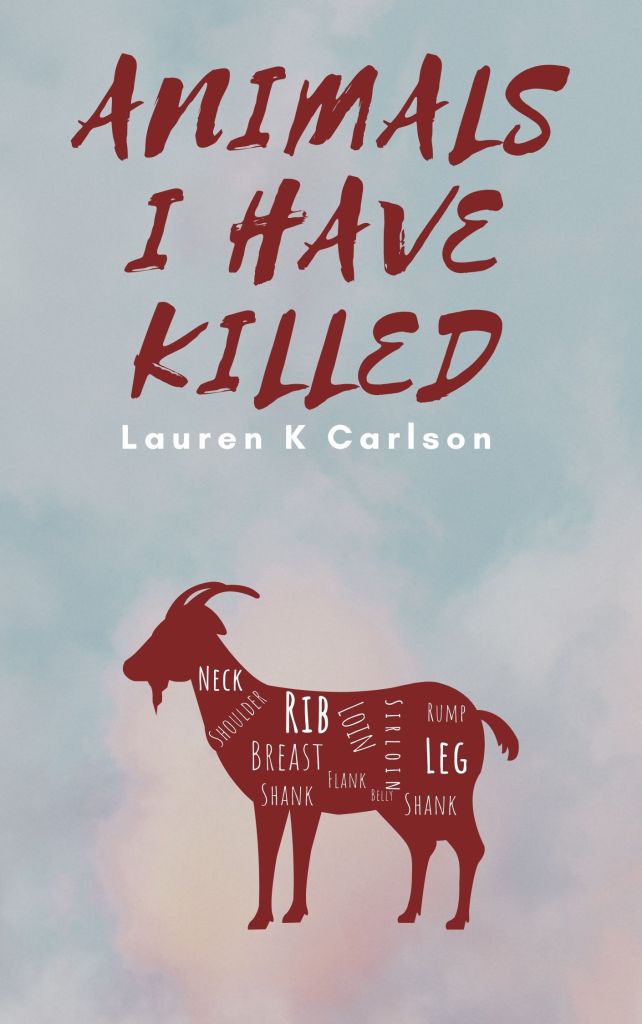
JENNIFER SPERRY STEINORTH REVIEWS ‘ANIMALS I HAVE KILLED’by LAUREN K. CARLSON
In her first poetry collection, Animals I Have Killed, Lauren K. Carlson delivers poems that incarnate rare and ordinary alchemies of biology and consciousness. Through deft deployment of metaphor and syntactic sleight of hand, Animals I Have Killed bears witness to daily transformations of animal into meat, human into animal, and God into word into night. In Carlson’s hands, rifles become sentences, children become windows, a young woman becomes the unopened mail of her recently departed grandmother. What’s more, through the keen eye of our poet/witness, each embodiment reveals its tethers to all the others; we are given to see not only the lit stage of the theatre, but the puppeteer overhead, past and future scenes waiting in the wings, our own faces aglow in the darkened house and all the strings.
Consider Carlson’s startling title, Animals I Have Killed. Grammatically, the phrase implies the book’s subject is animals, and certainly this is true. As it happens the poet resides on a family farm replete with goats, chickens, dogs, and numerous wild creatures. But Carlson’s title is complicated by the startling adjectival declaration “I have killed” which immediately shifts the gravitational power from the “animals” to the “I” that killed them. With these four words, Carlson enacts the violence whereby an animal is extinguished by an “I”, and, in so far as we consider such acts of violence to be the “savage” domain of animals, Carlson concedes to being an animal. Indeed, the simultaneous transfiguration of animal into weaponized “I” and “I” into an animal at the mercy of another is a recurring motif.
Take the poem “Migrations” which begins, “of silver air the starlings/ under thunderheads/ tumbling as one/the flock chasing storms”, then startles with “this swoop is not a doom”. Certainly, the slippery syntax which constructs a parallel between the birds in flight and the storm is a kind of magic. The phrase “tumbling as one” might refer to the flock of many birds, or the collect of thunderheads, or the flock and the clouds together made one. Stretched across the page, with ellipses between phrases, the words both semantically and visually represent both birds and clouds, each fragment occupying its own piece of sky. The empty space around the fragments becomes the firmament stitching them together, dissolving distinction between, so that when we arrive at “this swoop is not a doom” we are astonished by the sudden appearance of a threat the speaker claims is absent. Doom may not be this swoop, but it might be the next. At the close of the poem, the speaker declares “a night with no light” to be “what else but a room/ a womb/ the newborn once home”. Suddenly we understand the heightened awe and terror of the speaker beholding the sky when, in addition to the migrations of weather and birds we consider the migration of an infant, of one’s own child, from womb into wide world and from hospital to home.
In Carlson’s poems metaphor is not simply a mechanical device, but an enactment of spiritual transubstantiation. We see this in “Mary Teaches Me the Sacrament” which begins:
When I tell					my son
our neighbor					died this morning
he weeps					at eight

his emotions					hovering near the surface
The poem may be read in several ways, both horizontally across the page and vertically down, one column at a time. This formal play, whereby multiple readings coexist and complicate each other, embodies a metaphysical revelation. Reading across the columns horizontally, we understand the speaker is telling her son that their neighbor has died; the son, eight years old, weeps. The title, with its invocation of Mary and the Christian faith, complicates this reading as we may interpret the word neighbor to be a stand-in for Jesus, and the telling to be that of the Easter story. If we read each column vertically other meanings emerge. The second column is particularly resonant: my son/ died this morning/ at eight. We may understand the speaker to be Mary the mother of Jesus, recalling her son’s death (at eight A.M). But from the first reading we understand the primary speaker–to whom Mary teaches the sacrament– is also a mother, and as a mother, how can she not empathize with Mary’s loss? In these first few lines, not only do we witness several transfigurations– the present day mother into Mary, mother of God, the deceased neighbor into Jesus, Jesus into the speaker’s own eight year old son (to name a few), but the choices of interpretation which become the responsibility of the reader, transforms the reader from passive witness to active agent of creation, culpable for the transformations they conceive.
Indeed, agency and grace walk hand in hand throughout Animals I Have Killed. In the semi-confessional title poem, the poet meditates not only on the particular animals she has killed (do the goats we take to the butcher count?), but the reason and method of death: the rooster burned alive for attacking my son. In these poems the poet reveals the dirt on her hands, washes them in real, coagulating blood. Such revelations invite readers to consider their own frailty in the wake of all that is beyond our kin alongside our terrifying power in the lives of others.
The alchemical magic of Animals I Have Killed calls us to our better selves, not only through deft deployment of a poet’s craft, but through a pilgrim’s devotion to the gifts of creation– the starling and the storm, the hunger and the meat. It leaves this reader hopeful, curious and longing for more.
Jennifer Sperry Steinorth’s books include Her Read A Graphic Poem (2021) and A Wake with Nine Shades (2019) from Texas Review Press. A poet, educator, interdisciplinary artist, and licensed builder, her recent work has appeared in Black Warrior, Cincinnati Review, Michigan Quarterly, Missouri Review, Pleiades, Plume, Rhino, TriQuarterly and elsewhere.
Yom Kippur 5781
I.
I have cancer.
Daven* in the infusion room.
Power port accessed.
Blood tubes filled.
A soul with a pole: fluids, Benadryl, magnesium, Erbitux.
Lean back, heated recliner, warm blanket.
The holiest day of the year.
Worship on my cell phone.
Rabbi, Cantor chant into silence.
An aide brings chicken soup.
My fast, forbidden.
Rabbi delivers her sermon.
A spoonful for each reflection.
A sin reversed like failed intentions.
Pound the chest. Repent.
II.
The man in the adjacent cubby, short of breath, keens.
Nurses take his vitals, wash his head with a cold cloth.
His voice cracks with pain, fear.
Let me go home. Acooing, calm reply,
You have a fever. It may be an infection, it may be the chemo. They’ll order tests in the E/R. Get this under control.
EMT’s summoned.
I imagine––one nurse massages his shoulders,
another holds his hand, a third readies his bags.
The crash cart rolls by, parked out of his view.
EMT’s arrive. A gurney with its own pole.
III.
The Yizkor* service.
Tears,
the tom-tom for the liturgy,
absent from Temple.
I cannot offer tissues,
jealous,
eyes dry,
scared of what could make me cry.
* Daven: Chant prayers
* Yizkor: Remembrance (Memorial) Service for the dead
When not writing about rock ’n roll or youthful transgressions, Richard Fox focuses on cancer from the patient’s point of view drawing on hope, humor, and unforeseen gifts. He is the author of four poetry collections and the winner of the 2017 Frank O’Hara Prize. – smallpoetatlarge.com
The Hollybrook Harp
Boxed in deep sedimented paint and peat
and time, you are the willowed window
through which we listen darkly.
Phantom strain above intersecting joints
you wire us into the dim reverberations
of sustaining songs and sorrows.
Cassocked in unremarkable layers
black light alone illuminates your depths
and bares your tattooed shoulder.
Absence is windowed by your frame.
Still, bog priestess, it is you
that moves the air to music.
Robert Stewart Heaney is a teacher and writer. He is the author of three scholarly books and editor and contributor to numerous collections on religious thought, history, and the intersections of art and transformative action. Originally from Ireland, he holds a D.Phil from the University of Oxford and lives and works in the USA.
Hagiography


Over the course of 2017,
Mary Margaret Sellers –
named after both
her grandmothers (neither
of whom was a woman of repute) –
stole:

a women’s running shoe blue (the left one),
a pair of elephant salt and pepper shakers,
the change out of a “Ride This Buckin’ Bronco”
             machine in front of a 7-11,
her copy of The End of the Affair back
             from her younger brother (Jacko),
thirteen pink lawn flamingos,
her mother’s Amazon Prime account password,
a taxi from the elderly woman
             who was on her way to the bank,
half a tank of gas (mostly accidently),
$2.38 in coins out of a fountain,
             and
a pair of denim overalls that turned out
             to have a rip
             in the rear.

Mary Margaret confessed
the stealing (along with quite a few
other sins) at the Oratory of St. Juniper
in Mission Park, NC.

In the confessional, the priest –
middle-aged, graying, but not yet tired
of offering undue mercy –
asked Mary Margaret to close her eyes
and imagine
Jesus
sitting in front of her.

How is he looking at you?
What is in his eyes?

Mary Margaret left haunted
by what she saw in the light
of that stained-glassed room.

Time did not let her thefts go
unanswered.
Mary Margaret died
at the age of 28
from pancreatic cancer.

She was buried in the graveyard
of the Oratory whose priests often find
“borrowed” objects atop her gravestone:
a too-small yellow raincoat,
a weather-beaten copy of Brideshead,
a broken bike lock,
a chipped diner mug,
the occasional candle from the Oratory’s offertory table.

St. Mary Margaret’s devotees celebrate
her feast day
by leaving loose change
on the window sills
of their neighbors.
Mallory Nygard lives and writes in East Tennessee. Her poetry has appeared in Relief: A Journal of Art and Faith and Ever Eden Literary Journal. Her poem ‘Song of Sarajevo’ was named Best in Show at the 2021 Rehumanize International Create | Encounter. Her first collection of poetry, Pelican, was released in 2021.
THE STAIRSJerusalem
Stairway of Ahaz
671 B.C.
Time
reversed,
and down the stairs
the sun that travelled up
begins descent.
The same hour comes again,
yet the shadows record no history.
And I, Hezekiah, have been given
a willing sign of promised life, am
spared my demise by a poultice of figs.
The steaming cauldron of fever,
the grim phantoms parading before me,
the grey-green specter of death, gone.
And what is it that I must learn?
Perhaps in repetition to focus
on the presence of God in every second.
Time has been deemed as straight, measured.
Perhaps not. Is it a bubble then in eternity
whose contents can be replayed indefinitely
in the infinite?
Abrasion of light;
Abeyance of what was mine or might be mine.
I am without and within.
And I am ascended…caught other worldly,
in dark diamond blue.
I know the number of my years.
Paused, I sense my anguished failings, and know
the limitless in praise and adoration.
In sickle-light, sun moving between obstacles,
I am summoned into the sublime.
My libation is poured out
and renewed, poured again.
Ann Power is a retired faculty member from The University of Alabama. She enjoys writing historical sketches as well as poems based in the kingdoms of magical realism. Her work has appeared in: Spillway, Gargoyle, The Birmingham Poetry Review, The American Poetry Journal, Dappled Things, Caveat Lector, The Copperfield Review, and other journals.
Sunlight


Prayers are like the stones
carpeting the creek that flows
through the dark forest of depression,
its chilly water leading out
to a clearing, and then a grassy field,
and then sunlight.  To leave this place,
she needs to follow the creek stones,
and she’s out.  Never to return.  That
she can do.  But is she ready?  The beads
on her rosary are like the stones in this
creek.  Follow the stones to freedom.
Follow the stones, and she’s out.  One
stone, and then another, and then another.
Follow the prayers.  One bead, one prayer,
and then another, and then another.
And she’s out.  She chants the prayers
every night, fingers clicking: one bead,
one prayer, one bead, one prayer.  That
she can do. In the dark forest blue jays
feast on birdsong from tree to tree,
while the creek hums its rippling tune.
Is she ready?  Never to return.  Yes,
that she can do.  She climbs down
from the tree of betrayal, abandonment,
and abuse where she sleeps every
night.  One bead, and then another,
sliding between her fingers.  One prayer,
and then another.  Her toes touch creek water.
Cold.  Cold.  Keep going.  Keep moving
forward.  Keep praying.  One bead, one
prayer, and then another, and then another.
That she can do.  A feast of birdsong
tickles her ears.  One bead, one prayer.
One stone, and then another, and
then another.  Is she ready?  Yes,
that she can do.  Never to return.  One
stone, and then another, and then another.
And so it goes.  Finally, she reaches the
clearing.  And then the field.  Keep going.
Keep praying.  And then the kiss of sunlight
on the top of her head.  And then she’s out.
Out in the light.
She’s out.
Never to return.
Laura Stamps is a poet with several books, including IN THE GARDEN, THE YEAR OF THE CAT, and TUNING OUT. She is the recipient of seven Pushcart Prize nominations. Currently, Laura is working on a new poetry chapbook about PTSD and healing. Find her every day at Twitter: @LauraStamps16.

 Amethyst Review