Railway Fields – a poem by Anthony Tomkins

Railway Fields


Between our rubble sprawls 
is a crack of infinity. 
It fills the interregnum of every train journey. 

Dogwalkers – the sages of this space
traipse copse and field flank, 
breathe brownfield pleasure. 
They wander the Pindrop flatland with apothecary vials. 
Their sweetened tinctures a mud remedy. 

Steam rises from a pasty, seat 36
and the great synapse of flood glass reflections 
fragments past scarred windows. 
The scent of peppered turnip 
conjures a request stop:

Decanting into fields of oil-seed rape,
the Citizens of Carriage B watch 
muntjac fangs strip the fibres of burdock root,
and sweat in the herbalist air.

Anthony Tomkins is a PhD researcher with the University of York’s English and Related Literature Department, working on athletic memoirs. He writes about ethereal nature and the sublime landscape of his Brecon Beacons home. 

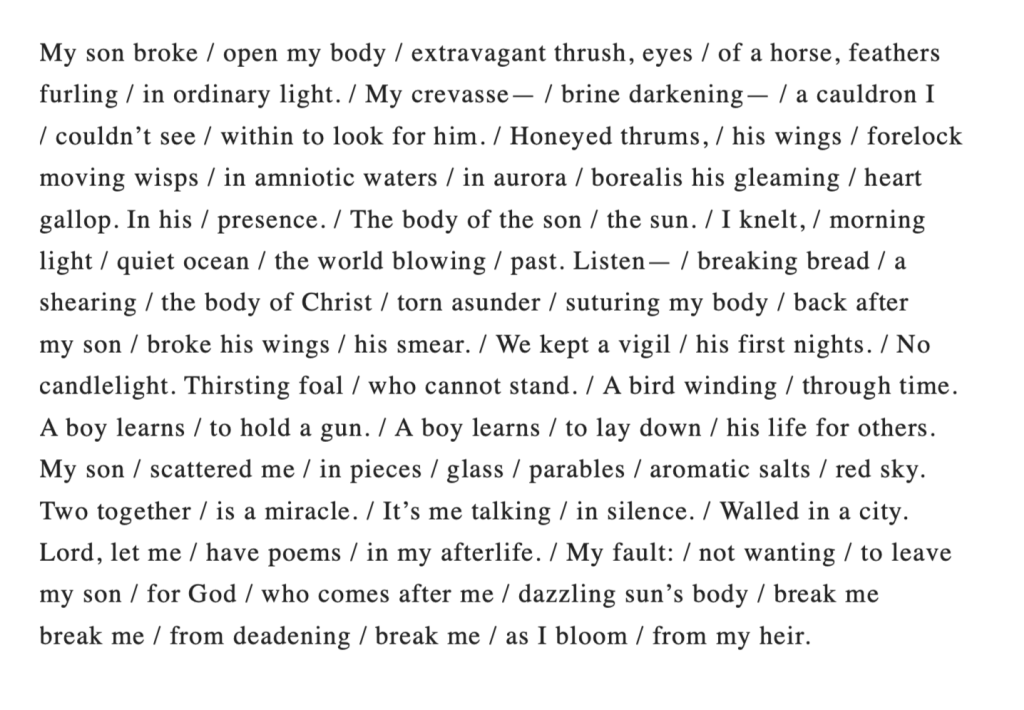
Locution I: We are more wretched than the animals – a poem by Nicole Rollender

Locution I: We are more wretched than the animals

A 2017 NJ Council on the Arts poetry fellow, Nicole Rollender is the author of the poetry collection, Louder Than Everything You Love (Five Oaks Press), and four poetry chapbooks. She has won poetry prizes from Palette Poetry, Gigantic Sequins, CALYX Journal and Ruminate Magazine. Her work appears in Alaska Quarterly Review, Best New Poets, Ninth Letter, Puerto del Sol, Salt Hill Journal and West Branch, among many other journals. She’s managing editor at THRUSH Poetry Journal. Nicole holds an MFA from the Pennsylvania State University. She’s also co-founder and CEO of Strand Writing Services. Visit her online: www.nicolemrollender.com.

Stick Figures – a poem by Terence Culleton

Stick Figures


Two, jogging way up there along the beach
in hoodies, spindly in the sun. Waves reach
to touch about their shadows, which pull back,
then jab out suddenly again—flicked, black
switchblades bobbing straight along in sync.
They merge a moment now, now they shrink
apart again, a sparkling flop-eared dog
galumphing up ahead, meet analogue,
if there ever could be, or couldn’t, for
a kind of love still wagging anymore,
some image, some weird numinous embrace
receding forward, way up past that place,
past rocks and sea-cress, tide pools—shining—white—
something: a laid out open palm of light.

A two-time Pushcart nominee, Terence Culleton has published three collections of formally crafted narrative and lyric poems, including A Communion of Saints and Eternal Life (both out through Anaphora Literary Press) and, most recently, A Tree and Gone, a collection of formal English sonnets out in 2021 through Future Cycle Press. Sonnets from A Tree and Gone have appeared in Antiphon, Better Than Starbucks (featured poem), Blue Unicorn, Eclectic Muse, Innisfree, Orbis (Readers’ Choice), Raintown Review, Schuylkyll Valley Journal (featured poet), and numerous other anthologies and journals. A Tree and Gone is available at https://amzn.to/3qDrRqN or through his website, terenceculletonpoetry.com.

Jonah – a poem by Matthew King

Jonah


When God regrets agreeing
to deals he made with devils
devised with dark designs
he appeals to sunken creatures
for whom he chose a flood
so that evils would survive
to be summoned from the seas
when he needs something to swallow
his own graven image.

And when he’s half-digested,
reformed with dovish graces,
the man’s regurgitated
on foreign shores for salvage.
He puts his ear to shells
he’s scavenged from the wreckage
and listens for his message
     
     susurring 
          
          in the waves

Matthew King used to teach philosophy at York University in Toronto, Canada; he now lives in what Al Purdy called “the country north of Belleville”, where he tries to grow things, counts birds, takes pictures of flowers with bugs on them, and walks a rope bridge between the neighbouring mountaintops of philosophy and poetry. He is on the web at birdsandbeesandblooms.com, and on twitter @cincinnatus_c_.

The Shadow Keeper – a poem by Sarah Greenwood

The Shadow Keeper


I am as full and as empty as the moon
I walk down steps and they echo back into me
as if there is nothing there
A skin stretched as over drum
around a skeleton
fragile and crisp as shell

I am silence
I walk into white noise
I have no questions and I have a 
thousand questions

I am ocean
I have no say in where I go 
I obey the moon
I ask           no questions 
I tell            nobody
I forfeit myself
over and over
lapping lightly at the sand
letting it bury me slowly
Offering up shells of the dead
I pave my way
to being loved

I am moon
I turn my face to the sun 
and light places underground 
I didn't know were there
My back is cold
My back can take it
stowing shadows like folded laundry 
Rare and solitary
My naked back
is beautiful


Sarah Greenwood is a poet and translator of Portuguese to English who uprooted herself to the Algarve 16 years ago. Her writing explores themes of identity, spirituality and the relationship we weave with place and time. She is a mother and a birth rights activist.

St. John of the Cross and the Bird – a poem by Kath Higgens

St. John of the Cross and the Bird


There was a solitary bird,
a non-descript brown little job,
unnoticed by everybody,
sitting high on a pole,
her head to the wind.

The Beloved said to her,
“Little brown bird, why are you alone?”
And she replied,
“Beloved, I am here only for you.”

And the Beloved spoke to her again:
“What is your song? Where is your voice?”
And the solitary bird replied,
“I cannot find my voice.
Beloved, can you give me something to say?”
And the Beloved said,
“I hear your silence,
I hear your solitude,
I hear your longing and your desires.”

And the little bird asked,
“My Beloved, is it enough?”
And the Beloved said,
“As you breathe the air,
as you balance on the post,
as you face into the wind,
as you long only for me,
this is your voice that I hear.
Be satisfied. Be fulfilled.
There is enough noise in the world,
and it cannot drown out your silence.”

Kath Higgens originally from UK worked for many years in the field of Bible Translation in Central Africa, before retiring to a contemplative life-style in South Africa. Though poetry has long been a passion, she has come late to writing her own.

Up – a poem by Melanie Branton

Up 

I’ve turned the world upside down and stacked it 
on top of the morning, so I can sweep and mop 
under it, wipe away other people’s muddy footprints. My thoughts 
are clear when the roads are clear, occasional traffic moving at an affable pace. 

A blizzard of time has fallen in the night, and I’m the first one to walk on it. 
Tensing Norgay on the top of the world, I have conquered 
the new day, stuck my flag in it. My phone says 4.58, 
as I catch the door with my foot, so it clicks, it doesn’t bang. 

Early morning is eating porridge when everyone else 
is eating Frosties or Cheerios, porridge with blackberries, 
that tastes like pudding. I’m surrounded by a warm halo, like the Ready Brek kids. Steamed broccoli with brown rice, a new potato, still in its jacket. 

Early morning is a jug of freshly brewed, hot, black coffee, 
that smells of buttered toast and caramel, but only five calories a cup. 
It bones my corset, my push-up bra, bicycle pumps 
my paddling pool body, and makes my heart beat again. 

Dark? Yes, but it’s a different dark from evening dark: 
navy bluer. Just back from the dry cleaner, still in its polythene wrap 
on a wire coat hanger, a ticket safety-pinned to the inside lapel, 
smelling of pear drops and formaldehyde. The sky is wearing its school uniform, 

it’s polished its shoes and pinned the stars to its breast, a shiny prefect’s badge. 
It’s pulled its hair back from its face and fastened it 
with a velvet Alice band. It’s on its best behaviour, 
an ambassador for its school. It has perfect table manners. 

Early morning is a warm church on a cold night. The things that lurk 
in darkness can’t touch me here. There are candles burning 
and the smell of wax polish, brass eagles with heavy books on their backs, 
and a marble altar, a baptismal pool 

for total immersion, a voice crying in the wilderness, 
Prepare ye the way of the Lord! Purge me with hyssop, and I shall be clean: 
wash me, and I shall be whiter than snow. Cleansed on the inside, not on the outside. 
Outwardly unchanged, but inwardly made new. 

Early morning likes to surprise me with his sugar daddy gifts: 
a genuine fox fur! - with the fox still in it! – pops out of an alleyway, 
a champagne cork from a bottle, a showgirl from a cake. Ta-dah! And then 

                                                                                                                  the sun comes up!

An alchemist who crystallises the sky to amethyst, 
tiger’s eye quartz, lapis lazuli, aquamarine. 
The aloneness and the new light are a microscope, a spotlight, 

narrow my focus to the point, to the fine detail that is everything 
I would have missed, so I emerge from the darkness, grateful for people 
who grow roses in their gardens, strain their muscles 
to give flowers to strangers, because that’s what humans do

Melanie Branton is a spoken word artist and education support worker from Bristol. Her published collections are Can You See Where I’m Coming From? (Burning Eye, 2018) and My Cloth-Eared Heart (Oversteps, 2017).

‘The jackdaws caw and do not care’ – a poem by JM Summers

The jackdaws caw and do not care 
that for a moment we allowed 
ourselves to dream. Do they look 
out across the waters they do 
not allow themselves to visit 
and wonder, still, and dream, 
too? In the chapel we are 
invited to pray, as if in the 
hush of contemplation you might 
hear something other than the 
thoughts you yourself offer up.
But hush, now, and listen, as
if there, in the midst of the 
dream, the answer might come.
The still, small voice you are 
perhaps not too deaf yet to hear.
The narrower way you might yet 
give yourself leave to follow.

JM Summers is an IT Consultant, blogger, and busy father of three. Previous publication credits include Another Country from Gomer Press, Borderlines, Blithe Spirit and Presence. He is the former editor of a number of small press magazines. He has published one book, Niamh, a collection of prose and poetry.

Evening Walk – a poem by Sarah Tate

Evening Walk

Gathering clouds like bunches of fat above. 
Gray, wavery, a reflection that trembles. 
The leaves droop down around me, hundreds
of sinners shivering at the steps of the temple.
It smells like rain, asphalt, an old memory, even. 

I will always be afraid of my parents dying.
All those theologians in books
writing about death gentle-like,
but I’d love for grace to thunk me on the skull
if it meant answers written on the walls. 

At least the puddles have gathered politely 
against the curbs. I walk with my fingers 
curled like I’m holding a cigarette. 
For looks, for the plain sense of it, just to cope. 
I won’t to avoid gums lined with licorice black,
and no sermon ever taught me how to smoke.

Forever it seems God speaks words
through the sounds of extinct birds, 
and eternity hides like a cricket in the bush. 
Like death is an expansion of life,
and I want to laugh at that joke
because who thinks so 
staring at an earth-mound filled to the brim
with memories roaming like ghosts?

Three crows chime at me from the power lines. 
A bad omen, those squawks, if I believed so. 
I pass a string of bushes on the walk, their red
berries match flames among the shadows. 
Clouds break, and sunset nestles on the horizon, 
a bowl of blood-red swaddling the earth. 

I don’t know what I mean. I am the leaf
that trembles at the bottom of the temple stairs. 
I am undone by questions that have no shape,
words like rabble thrown in the gutters. 
Has that really settled the matter?
Who but God knows how the force of disorder
also means a sense of plenty—
bridges strangled by vines, clearings 
dotted with wildflowers like flames, 
the pale blue network of my veins. 

Streetlight shadows stretch over my head,
and the last bit of light slinks away 
before night’s iron seas roll in, 
but the light will spring lively again. 
All the answers will finger the walls,
as if the poetry of the earth, the sounds of God,
are those three birds chiming on the power lines, 
framed by fading gold, dusty and blurry, 
like three old dimes lifted to the light. 

Sarah Tate is a writer, a poet, and a life-long student of literature. Her work has previously appeared in Calla PressHeart of Flesh Literary Journal, and LAMP. She lives in rural Virginia where she especially enjoys long walks and contemplating things she doesn’t understand. 

The Hard Winds of Kentucky – a poem by Sarah Mackey Kirby

The Hard Winds of Kentucky
 
I know you, Old Kentucky. Your petal hands
below the callused hard. Your Tulip Poplar
mornings, branches lifting prayers into the gray.
 
It’s December now, and the Cooper’s hawks
forget which way to fly. A raging torrent
sweeps suffering to folks already grasping
 
for a light. It’s how it always is, isn’t it. Since
time was born, those struggling pay the highest
price. Signs of love pour in from every corner,
 
over broken-porch-swing fields and dreams in rust.
Stories lay scattered through the shadows, waiting for
a cue. To tell their newest twist on starting again.

Sarah Mackey Kirby grew up in Louisville Kentucky. She is the author of the poetry collection, The Taste of Your Music (Impspired, 2021) Her work has been published in Impspired Magazine, Muddy River Poetry Review,Ploughshares,  Third Wednesday Magazine, and elsewhere. Sarah loves to cook and feel summer dirt on her hands. She and her husband split their time between Kentucky and Ohio. https://smkirby.com/