Rupert Loydell is a writer, editor and abstract artist. His many books of poetry include Dear Mary (Shearsman, 2017) and The Return of the Man Who Has Everything (Shearsman 2015); and he has edited anthologies such as Yesterday’s Music Today (co-edited with Mike Ferguson, Knives Forks and Spoons Press 2014), and Troubles Swapped for Something Fresh: manifestos and unmanifestos (Salt, 2010)
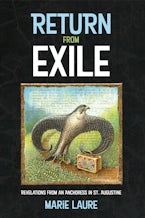
Marie Laure’s Return from Exile is compelling read: part personal memoir, part spiritual memoir, part travelogue, and part pilgrimage, it is uniquely of our time, but is rich with history and a certain timelessness too. Laure is an American writer who longs to travel to Norwich, feeling a particular affinity for Norwich’s famous medieval anchoress, Mother Julian (1343-c.1416), author of the Revelations of Divine Love. Laure is drawn to Julian’s life of sacred seclusion, her many years spent in prayer after a series of visions experienced (Julian tells us) during a severe illness when she was thirty. She imagines Julian in later life, writing, reflecting, and gaining new perspectives, just as Laure plans to do herself.
Laure’s route to Julian’s anchorhold is circuitous, digressive; her first planned journey stymied by an overbooked flight and further plans suspended during months of lockdown due to the pandemic. But this very much suits the nature of creative nonfiction, allowing for events to be juxtaposed with theological insights (Laure wears her learning lightly, but is fluent in several spiritual traditions), and embedded in historical or biographical contexts – these include some fascinating revelatory flashes that foreshadow Laure’s future path. In the book’s first half, we get to know Laure and her family, especially her much-loved adult daughter Hannah, from whom Laure is loosening her maternal bonds in a process that is painful, slow, but ultimately transformative. Just as Julian once did, Laure too is embarking on a new state of life, in her own case in St Augustine, Florida. While Laure’s fascination with Julian as anchoress grows, so too does her appreciation of her own parallel vocation of ‘forest dweller’, the spiritual path she ultimately embraces; a state of life particularly attuned to trees, landscape, the elements, and the cosmos. But she often feels alone, an existential loneliness many of us can identify with, particularly now: how true it is that ‘we often feel alienated, separated, apart from one another, as if in exile’ (p.21).
Finally, the ‘auspicious time’ to make her pilgrimage arrives. At first wary of identifying herself as pilgrim rather than tourist, Laure encounters history, culture, and spiritual serendipity in London, including the spine-tingling privilege of viewing an early manuscript of the Revelations in the British Library. Her stay in Norwich is of course the heart of the pilgrimage, (and particularly interesting to me, being Norwich born and bred!). She takes a great delight – understandably – in the magnificent Cathedral, as well as its lesser-known library. It’s delightful to learn, too, that Laure has followed the progress of the peregrine falcons nesting in a cathedral parapet, via webcam from across the Atlantic, and now in close range.
If Laure experiences some aspects of her Norwich sojourn as joyful, she is also honest about the realities of her visit to the reconstructed anchorhold (a quiet cell with altar and candles) in St Julian’s church. The visit leads her to review and refine her plans for her own spirit-filled ‘third life’. Like most of us, Laure would find the enclosure of a literal anchorhold too much to bear, even while Julian’s wisdom is very much ours to cherish. But we can all benefit from cultivating an inner anchorhold, and consulting the wisdom of Julian as we learn about her life and writing. And what a Julian-like insight that Laure later has, when she understands the profound words from the Revelations inscribed in the cell, ‘Thou art enough for me’, as spoken to her by God, as much as the other way round.
Reading Laure’s memoir, I was struck by how much she trusts us, her readers, to hear her story with all its hurts, tangents, encounters and insights. It is almost as though we are asked not just to journey along with her, but to welcome her story into our own hearts with the attentive compassion of Mother Julian herself. We are, implicitly, invited by Laure to be Julian, even as she invites us to consider how much we also need Julian.
Two of Laure’s more explicit insights also stood out as particularly valuable. The first is not a new one, but a reaffirmation of Julian’s experience of Christ as maternal. We do not know, but many suspect that Mother Julian had her own experience of biological motherhood, possibly losing her family in one of the waves of plague that swept over England in the fourteenth century. Julian specifically mentions her own mother being present at the time of her own illness. Her visions and understanding of Christ as mother have only increased in resonance. Laure puts it wonderfully: ‘This is what Julian is all about: mothering love guaranteed unconditionally, endlessly, and eternally’(p.100).
The second insight Laure shares is the centrality of healing in the spiritual life, and the value of praying for healing as spiritual practice. Healing in a wide, symbolic sense, of course, but also healing as specific and relevant to our embodied selves. Particularly so at time of the book’s writing, when the global pandemic has forced us to confront our physical frailty with some urgency. Laure is gently guided to pray for healing; in particular, she asks for, and experiences, healing of the heart, on both spiritual and physiological levels.
A pilgrimage is a personal journey, especially when travelling alone, as Laure did. It is full of meaning, both scheduled and unexpected: Laure quotes Phil Cousineau’s 1998 book The Art of Pilgrimage: ‘In sacred travel, every experience is uncanny. No encounter is without meaning.’ (p.81). However, the fruits of a pilgrimage are certainly not limited to the pilgrim, and here they are not limited to Laure’s own spiritual growth. For Julian, and for all those who follow a contemplative way, ‘activity within the heart is ongoing and lively’ (p.32), and leads to connection, not isolation. This is made manifest in a powerfully poignant encounter with a bereaved grandfather on Laure’s flight home. No longer in existential exile, Laure responds as an authentic listener, offering something of Julian’s own compassion in the enclosed, liminal space of an aeroplane in flight. And now we have Laure’s published book too, which I warmly recommend for reading and revisiting.
Niche


I walk my dog on broken path
That crumbles into ocean tides.
High voltage lines above divides
The world below from aftermath.

The rain drives down. The storm hath
Blitzed. My intentions it derides.
I walk my dog on broken path.

If one still doubts, he checks the math
Or knows the way that God provides.
Apart I step, still mud abides,
Past woodsy niche I face that wrath.
I walk my dog on broken path.
Dennis Daly has previously published seven books of poetry. He writes reviews regularly for the Boston Area Small Press and Poetry Scene, the Somerville Times, and Wilderness House Literary Review, and on occasion for Ibbetson Street, the Notre Dame Review and Boston College’s Religion and the Arts. Please visit his blog at dennisfdaly.blogspot.com.
Working from Home (La Dolce Vita)


Monday morning, and I’m meant to be working, but how can I,
what with the men and their machines digging up the street below?
I’ve tried white noise, but my ears get hot. I’ve tried ocean waves
crashing against the shore, downpours in tropical rainforests.

I was livid when they showed up. We’re all working from home you know!
The pavement opposite is newly cobbled and looking beautiful.
I felt proud of them. Then last week, nothing – not a man, not a van,
not a pneumatic drill. Had they achieved too much too quickly?

They’re back today. And the gas people have got the slabs up.
I just watched a man fix a chain around the neck of an old
parking meter, then stand back as his mate in the Caterpillar
ripped it from the road, hoisting it into the air, holding it up high

like the statue of Jesus with outspread arms, carried by helicopter
over the rooftops of Rome in the opening scene from Fellini.
Paul Stephenson has three pamphlets: Those People (Smith/Doorstop, 2015), The Days that Followed Paris(HappenStance, 2016) and Selfie with Waterlilies (Paper Swans Press, 2017). He co-curates Poetry in Aldeburgh and currently lives between Cambridge and Brussels.
Expectations
           — after Clock with Blue Wing, 1949 Marc Chagall

A woman, with a wide-eyed stare, stands in night’s
    open doorway, watching the sparks of fireflies rise
above the village’s clay roofs into the skies of Scorpius.

She looks and looks and looks, with her arms holding
     herself still in the intimate hour of ten past ten, imagining
stolen kisses that once were hers, long ago, in the shadows

of the intricate clock whose precise works didn’t chime
     its warning, like the morning’s rooster or the fleeting black-
bird’s dark wing passing overhead like a sleight of hand . . .

So warm that night, she can still smell the perfume of roses
    and hear the yelp of hunting dogs running in hedgerows.
She thinks of Artemis who, like her, never married, but

was one to live alone among snow-covered mountains.
   She learned all this the hard way—to understand the price
of happiness.  Or, was it what the itinerant man told her

that summer night?  To carry something unknown to
  someone who would accept it in good faith, like her
broken clock, keeping the intimate hour of ten past ten.
M.J. Iuppa’s fourth poetry collection is This Thirst (Kelsay Books, 2017). For the past 33 years, she has lived on a small farm near the shores of Lake Ontario. Check out her blog: mjiuppa.blogspot.com for her musings on writing, sustainability & life’s stew.
Mammina proves the existence of God

The day is on its hands and knees. Mammina basks
on the balcony in great-grandmother dignity,
in all the quiet of a woman who has outlived her daughter,
collarbones glistening, little cross flashing pink
and gold among rivulets of August evening sweat
as the sun finally loses its grip and goes down fighting,
painting the duomo in eyeshadow colours.
The whole horizon is made of churches.

An ambulance squeals along an unseen street,
not the smooth wail of the ambulances back home,
but a desperate, discombobulated sound like the cry
of a confused animal. Mammina makes the sign of the cross,
lets loose a fast prayer. Her words are a string
of small, round beads, tumbling one after the other.

How can you be so sure anyone is listening? I ask
in her bubbling tongue. My head is dusky with
the sweetness the city gives off at the height of summer,
and with all my days and nights at university.

Mammina opens one eye, closes it, smiles back in her chair,
takes a fat medjool date between leathery thumb and
forefinger, squeezes it lightly, and says,
This perfect thing does not exist by accident.


Mary Ford Neal is a writer and academic living and working in the West of Scotland. Her poetry is widely published/forthcoming in magazines including Long Poem Magazine, Atrium, Ink Sweat & Tears, The Madrigal, Capsule Stories, and Marble. Her debut collection ‘Dawning’ was published by Indigo Dreams Publishing in August 2021. Mary is assistant editor of Nine Pens Press and ‘192’ Magazine.
At Bedtime


we are reading
about the boy
who held his finger in a dike
keeping the ocean at bay
Rescued and back home
he kneeled to say his prayers

             What are prayers

             my little girl asks
I swallow doubt and sigh
It's when you talk with God
tell what you need
listen for answers
say thank you
             Oh she says   then silence
             She'd heard that word before
             adults swearing
             Oh my God

The Dutch boy in the tale
felt the water's heavy mystery
saw the odds against him
grow like the sea-wall crack
but he kept plugging the leak
He knew he needed others
to miss him
to find him
to shore up the dike
He knew who to thank

Waiting for help or ruin
did the boy whisper a plea
and listen in silence
             Quiet for now   does my girl
             feel the current of the night
             hear the rush of salt water
             under her skin
Jan Seagrave has been a writer for universities, a storyteller, and a librarian. Her work appears or is forthcoming in San Pedro River Review;Gyroscope Review; Eunoia Review; Reverberations II, ed. Pendergast; Marin Poetry Center Anthology 2016,2017, 2021; Redwood Writers Poetry Anthology 2018-2021; Amore: Love Poems,ed. Tucker, 2016.
The Psalmody of Trees


We belong to each other.
My name inscribed in cursive
on your ruddy skin, your leaves falling,
shawling me in glorious greenery.

What I reflect on you have already seen.
Your limbs limn sacred texts pulled from
bounty's breezes. Your rustles echo heaven's
drum snares and whispering strings.

Together we sing in the same choir of air
savoring the long syllables of summertide.
But what a paradox we are, the soil
holding us even as we reach for the clouds.
Philip Kolin is the Distinguished Professor of English (Emeritus) and Editor Emeritus of the Southern Quarterly at the University of Southern Mississippi. He has published over 40 books, including twelve collections of poetry and chapbooks. Among his most recent titles are Emmett Till in Different States (Third World Press, 2015), Reaching Forever (Poiema Series, Cascade Books, 2019), Delta Tears (Main Street Rag, 2020), Wholly God’s:Poems (Wind and Water Press, 2021), and forthcoming Americorona: Poems about the Pandemic (Negative Capability Press, 2022).
Trance

Moon shaped as a C
for cancer
for chance
for cure.

The nurses hang
the bags of potions
casting the killing spells
on all his blood cells.

My ritual now:
Light an electric candle,
brew some herbal tea,
listen to the
whooshing
whishing
(wishing)
of the
cat-purring
pumps.

Pulsating pumping
in this room of
nearly-broken hearts.

Lying on the bed
across the room
from my sleeping son,

I squeeze
each separate
bead-bead-bead
of my Rosary;

“And blessed is the
fruit of thy womb...”

“And blessed is the
fruit of thy womb...”

Until I drift
into the trance
of night.

I awaken to
swishing
(wishing)
sounds
of the janitor
sweeping
her magic
broom wand,

ridding the room
of bacterium.

Morning sun conjures
a beam of golden light
onto his placid pale
puffy face-

An angel’s charm.

For today, the
umbilical cord cells
of another mother’s
womb-child will
resurrect his
blood.

The supernatural bond
between these children
never to be broken.

Stepping out of bed,
I walk to the mirror over
the sanitized sink where

the unrecognizable
frightened face
gazes back at me,
and asks again,

“Is this real?”
Lisa Molina is a writer and educator in Austin, Texas. She has taught high school English and theatre, served as Associate Publisher of Austin Family Magazine, and now works with students with special needs. Her writing can be found in Amethyst Review, Bright Flash Literary Review, Trouvaille Review, Beyond Words Magazine, Neologism Poetry, and The Ekphrastic Review. Molina was recently named Poet of the Week on the Instagram page of The Literatus Magazine.
Catherine Fletcher is a poet and a playwright. Recent work has appeared in The Hopper, Kissing Dynamite, Hopkins Review, Burning House Press, and the concert series Concept Lab. She was a TWP Science and Religion Fellow at Arizona State University from 2016-18. She also served as Director of Poetry Programs at the New York-based organization, City Lore. She lives in Virginia, USA.

 Amethyst Review