
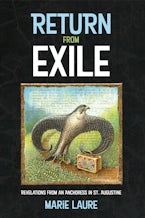
RETURN FROM EXILE: REVELATIONS FROM AN ANCHORESS IN ST. AUGUSTINE by Marie Laure: Wipf and Stock, Resource Publications 2021: Review by Sarah Law
Marie Laure’s Return from Exile is compelling read: part personal memoir, part spiritual memoir, part travelogue, and part pilgrimage, it is uniquely of our time, but is rich with history and a certain timelessness too. Laure is an American writer who longs to travel to Norwich, feeling a particular affinity for Norwich’s famous medieval anchoress, Mother Julian (1343-c.1416), author of the Revelations of Divine Love. Laure is drawn to Julian’s life of sacred seclusion, her many years spent in prayer after a series of visions experienced (Julian tells us) during a severe illness when she was thirty. She imagines Julian in later life, writing, reflecting, and gaining new perspectives, just as Laure plans to do herself.
Laure’s route to Julian’s anchorhold is circuitous, digressive; her first planned journey stymied by an overbooked flight and further plans suspended during months of lockdown due to the pandemic. But this very much suits the nature of creative nonfiction, allowing for events to be juxtaposed with theological insights (Laure wears her learning lightly, but is fluent in several spiritual traditions), and embedded in historical or biographical contexts – these include some fascinating revelatory flashes that foreshadow Laure’s future path. In the book’s first half, we get to know Laure and her family, especially her much-loved adult daughter Hannah, from whom Laure is loosening her maternal bonds in a process that is painful, slow, but ultimately transformative. Just as Julian once did, Laure too is embarking on a new state of life, in her own case in St Augustine, Florida. While Laure’s fascination with Julian as anchoress grows, so too does her appreciation of her own parallel vocation of ‘forest dweller’, the spiritual path she ultimately embraces; a state of life particularly attuned to trees, landscape, the elements, and the cosmos. But she often feels alone, an existential loneliness many of us can identify with, particularly now: how true it is that ‘we often feel alienated, separated, apart from one another, as if in exile’ (p.21).
Finally, the ‘auspicious time’ to make her pilgrimage arrives. At first wary of identifying herself as pilgrim rather than tourist, Laure encounters history, culture, and spiritual serendipity in London, including the spine-tingling privilege of viewing an early manuscript of the Revelations in the British Library. Her stay in Norwich is of course the heart of the pilgrimage, (and particularly interesting to me, being Norwich born and bred!). She takes a great delight – understandably – in the magnificent Cathedral, as well as its lesser-known library. It’s delightful to learn, too, that Laure has followed the progress of the peregrine falcons nesting in a cathedral parapet, via webcam from across the Atlantic, and now in close range.
If Laure experiences some aspects of her Norwich sojourn as joyful, she is also honest about the realities of her visit to the reconstructed anchorhold (a quiet cell with altar and candles) in St Julian’s church. The visit leads her to review and refine her plans for her own spirit-filled ‘third life’. Like most of us, Laure would find the enclosure of a literal anchorhold too much to bear, even while Julian’s wisdom is very much ours to cherish. But we can all benefit from cultivating an inner anchorhold, and consulting the wisdom of Julian as we learn about her life and writing. And what a Julian-like insight that Laure later has, when she understands the profound words from the Revelations inscribed in the cell, ‘Thou art enough for me’, as spoken to her by God, as much as the other way round.
Reading Laure’s memoir, I was struck by how much she trusts us, her readers, to hear her story with all its hurts, tangents, encounters and insights. It is almost as though we are asked not just to journey along with her, but to welcome her story into our own hearts with the attentive compassion of Mother Julian herself. We are, implicitly, invited by Laure to be Julian, even as she invites us to consider how much we also need Julian.
Two of Laure’s more explicit insights also stood out as particularly valuable. The first is not a new one, but a reaffirmation of Julian’s experience of Christ as maternal. We do not know, but many suspect that Mother Julian had her own experience of biological motherhood, possibly losing her family in one of the waves of plague that swept over England in the fourteenth century. Julian specifically mentions her own mother being present at the time of her own illness. Her visions and understanding of Christ as mother have only increased in resonance. Laure puts it wonderfully: ‘This is what Julian is all about: mothering love guaranteed unconditionally, endlessly, and eternally’ (p.100).
The second insight Laure shares is the centrality of healing in the spiritual life, and the value of praying for healing as spiritual practice. Healing in a wide, symbolic sense, of course, but also healing as specific and relevant to our embodied selves. Particularly so at time of the book’s writing, when the global pandemic has forced us to confront our physical frailty with some urgency. Laure is gently guided to pray for healing; in particular, she asks for, and experiences, healing of the heart, on both spiritual and physiological levels.
A pilgrimage is a personal journey, especially when travelling alone, as Laure did. It is full of meaning, both scheduled and unexpected: Laure quotes Phil Cousineau’s 1998 book The Art of Pilgrimage: ‘In sacred travel, every experience is uncanny. No encounter is without meaning.’ (p.81). However, the fruits of a pilgrimage are certainly not limited to the pilgrim, and here they are not limited to Laure’s own spiritual growth. For Julian, and for all those who follow a contemplative way, ‘activity within the heart is ongoing and lively’ (p.32), and leads to connection, not isolation. This is made manifest in a powerfully poignant encounter with a bereaved grandfather on Laure’s flight home. No longer in existential exile, Laure responds as an authentic listener, offering something of Julian’s own compassion in the enclosed, liminal space of an aeroplane in flight. And now we have Laure’s published book too, which I warmly recommend for reading and revisiting.
 Amethyst Review