
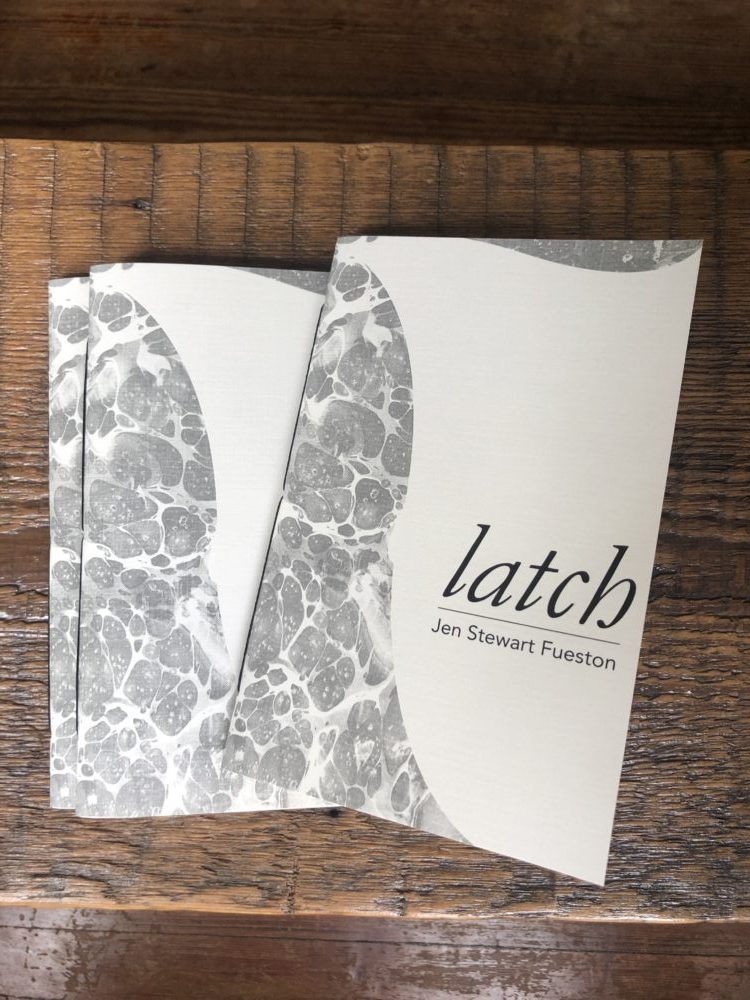
Latch: Poems by Jen Stewart Fueston – review by Sarah Law

Latch: Poems by Jen Stewart Fueston
www.riverglassbooks.com

I’m catching up with some great publications that have been sent to me over the course of this year, and, particularly in this Christmas season of celebrating a birth in all its fleshly and spiritual implications, I couldn’t do better than spend time with Jen Stewart Fueston’s chapbook Latch.

This is a powerful short collection with an overarching theme of birth and motherhood; a perennial experience presented afresh with rich lyricism. Motherhood in these poems is something longed for and experienced on a physical, spiritual, and emotional level, from the contingencies and difficulties of conception, through the self-emptying of birth, and the loosening of the self’s boundaries as a baby is breastfed (both the title term ‘latch’ and ‘milk’ are explored as potent words that function as both noun and verb). The poems are also alive to the metaphorical resonances of language; they are lucidly and sometimes playfully written, and because of this, touch on many other aspects of human experience too.

Even when not primarily evoking maternity, the poems are all personal and – to a greater or lesser degree – embodied: (‘The flesh permits departure /not escape. The body quieted, not shed,’ as noted in ‘A Swim’). But this embodied lyrical voice is coupled with an intense engagement with the world around us, in both nature and also art and culture. Nature features throughout of course – we, our embodied selves, are inextricably part of it – but also in moments of acute natural beauty, such as the jay, spied by mother and son in ‘Common Loon’:

His black eyes interrogate through glass,

his tufted twitching, speckled body
bobbing white and blue,
a blue like loss that fades into more blue.

In fact, there is a lot of blue in these poems, the colour itself becoming a particular locus of nature and spirituality, frequently merged together: the rich mineral blue of the Virgin Mary’s robes is the subject of ‘Ultramarine’, and, later, her ‘deep blue robes’ comfort the dead in ‘Pablo C. Tiersten, 38, Kansas City’. The ‘wide blue air’ is actively cradled by a vacated nest in ‘The Empty Nest’; the blue hues of water feature in ‘A Swim’ and the metaphor of a ‘blue-eyed mole’ for a wriggling son in ‘Zookeeper’.

As well as colour, there is an insightful, but still personal, affinity with art. I loved the imaginative engagement with famous paintings, such as the female model in ‘The Interior of Oude Kerk, Amsterdam’ whose weary head is ‘spinning with rough chores’, and the reimagined Mary of Dante Gabriel Rossetti’s ‘Annunciation’ in ‘The Virgin, Home from the Mall’ : ‘Her lips are rose, precisely lined./ She stopped off at Sephora for this shade, thornberry.’ Equally striking is the insight in ‘Taking the Baby to See Rothko at the National Gallery,’ where the non-figurative, visceral genius of Rothko’s art is unexpectedly appreciated by an infant who is ‘himself another masterpiece of bright, unsayable things.’

Stewart Fueston’s skills include a vivid, often quite delightful use of imagery – I was particularly struck by the descriptions of her baby son shapeshifting through a whole menagerie of animal metaphors in the already-mentioned ‘Zookeeper’: as well as a blue-eyed mole he is ‘a dangling possum’, ‘a four-limbed snake’, ‘the red hawk and I his next meal’ and ‘a bear cub against a drowsy mother’ (and more). I’d like to contrast this poem with, ‘Qualifications’, another long-line, list-based piece which showcases Stewart Fueston’s equally intense powers of perception of things in themselves. The poem should be read in its entirety for full effect, but the questions it poses make life vivid and precious:

Have you curved your hot palm around the soft crown
of a newborn’s head? Have you walked in a pine forest

after rain? Have you stood in the middle of soft lit bridge watching
the sun slip into the mirror of the river? …

Taken together, these skills of imagination and observation enhance a beautifully crafted poetic voice, making it both authentically centred and wide-ranging.

Finally, there is also a poignant acknowledgment, in some of these poems, of lives not conceived, and of things broken. As Stewart Fueston reminds us in ‘What Bears the Light’, it is brokenness (for example of glass, or mica-flecked stone) that reflects light best, and nature shows how being broken open leads to new growth and creativity. Witnessing to such is also intrinsic to the poetry here, as is our whole human experience of gathering up and letting go, intrinsic to each of us from the very beginning as evinced in bath-time play:

Learning again from him how to want
to gather everything,
and the play the water makes
as we let it go.
(‘Bath Time’)

Congratulations to Jen Stewart Fueston on this lovely chapbook. I hope this review inspires some more readers to seek it out.

Sarah Law

Icarus Imposter – a poem by Mark Tulin

Icarus Imposter

A jumping-off point
not very far from the sun
upon a vulnerable cliff,
the hang glider navigates
the wind and the clouds
and the unstable waves below.

It is the hang glider’s lament
to be the deity he is not.
Not a bird or an airplane.
Certainly not an angel
coming down to rescue us
or a saint to perform miracles
that raises us higher.

More likely, an Icarus imposter,
an intolerant risk-taker,
a power broker of higher altitudes
whose only saving grace
is to come down without a loud crash
or to cheat himself out of death.


Mark Tulin is a former family therapist from California.  He has a poetry chapbook, Magical Yogis, and two upcoming books, The Asthmatic Kid, and a poetry collection, Awkward Grace. He has appeared in Fiction on the Web, Free Verse Revolution, Leaves of Ink, among anthologies and podcasts. His website is Crow On The Wire.

Chrysler Aspen – a poem by Cameron Morse

Chrysler Aspen

Aspen leaves clap above Golfview,
light hand turning over dark hand, dark
over light, so swiftly a sort
of flicker ensues among the heart-shaped
and trembling leaves

whose heartfelt applause is hushed
with each passing pickup truck,
each black sedan, along Golfview Drive
where work is always being done.

Theo and I bark at the dog in the window
screen that is barking at us.
Cobwebbed yews blister with the red
berries I’m careful not to let Theo move to his mouth.

A Chrysler Aspen stirs an eddy of tiny leaves.


Cameron Morse lives with his wife Lili and son Theodore in Blue Springs, Missouri. His first collection, Fall Risk, won Glass Lyre Press’s 2018 Best Book Award. His latest is Terminal Destination (Spartan Press, 2019).


Buddha Smile, Siam – a poem by Victoria Crawford

Buddha Smile, Siam

A joy of jasmine day
with white petal scent in
Buddha’s topknot above his
bronze face
on a Chiang Mai wall
courtesy of Roone,
Siam housekeeper, lady of the flowers,
Buddha smile ineffable, slight.

That smile is metal molded
minimal upturn,
junk shop find in Kobe
near railroad train clatter,
the long earlobes,
inscrutable smile proclaim
his enlightenment,
the sharp crescent brows
his Asian home.

No name for that smile
only questions,
in a room moon-shadowed.
Does a tree falling in a forest
make a sound if no one
is there?

Hung on foreign walls,
often dusty, often ignored,
he seems at home
in Thailand, maybe the happiest
he’s ever been. It’s probably
Roone’s flowers; jasmine aroma
a smile.
Still, I look at that smile,
and always,
it is a koan to me.


American poet Victoria Crawford has lived in various Asian countries and now calls Thailand home. Her poems have appeared in Samsara, Time of Singing, Parousia, Braided Way, Heart of Flesh, and other journals.

Writing the Self Back In – a poem by Christine E. Black

Writing the Self Back In

Drop, leaf, chirp, cry,
A pen skims this toothed page,
Repeating the words – all the sorrow
Of the world, strong horses crumpling,
I write myself back in, bark curl, twig snap,
New green gathering lyric whispers
From a white page, Quiet lonely freedom,
Remembering all I tried to rescue
With my attention. Now, a stream trickles,
First bird sounds, Outline of leaf, memory chill,
A newborn’s warm tin smell of mineral love,
Sharp lines vulnerable in too much white space,
Blurred edges coming nearer, ideas flutter,
Taste like meat hunger on the tongue;
Like strong coffee; bourbon slick on ice,
Jeweled heavy-headed words, this writing
Making more, sweet definition’s
Lemon ache of my pulse.

Christine E. Black‘s work has been published in Aura Literary Arts Review, Antietam Review, 13thMoon, American Journal of Poetry, New Millennium Writings, Nimrod International, Red Rock Review, The Virginia Journal of Education, Friends Journal, The Veteran, Sojourners Magazine, Iris Magazine, English Journal, and other publications. Her poetry has been nominated for a Pushcart Prize and the Pablo Neruda Prize. She lives in Charlottesville, Virginia with her family.

Girl at the Window – a poem by Marilyn Grant

Girl at the Window

I’ve had my share of sad
stories, who hasn’t?
Even now I see her still, that young girl
kneeling on a stool by the window,
watching always watching lonely longing
unseen unnoticed her knees growing numb.

But today living brave
like the tireless hummingbird
that’s what I want, that
little marvel of energy whose
fragility belies its fierceness.
Everywhere I see effortless life
emerge into what it was meant to be,
like the crocus that blooms purple
brilliance even in desolate snow,
a spectacle unspectacular to itself.

Who am I then to mourn that lost girl
unknowingly growing wings of freedom?
I want remnants of the past to be
soaked clean in the stream of Love
that runs gently through my life.
A new story then will write itself.
Girl at the window, innocent curious tender.
Why not say there was a garden in her heart,
a gentle bud of love waiting to blossom,
a little Buddha in training sitting in silence,
loved never lost but like a newborn star
not yet able to realize its own radiance.


Marilyn Grant taught Creative Writing at Cerritos College, CA, where she was an adjunct professor of English, and journal writing workshops for Orange County Hospice nurses.  Roger Housden, a published author, was her teacher for a memoir writing course, and she is a member of Writers4Writers in Orange County, CA.  She recently joined a nationwide group of spiritual seekers called “We Awakening Circle.”

Poetry – a poem by Seth Jani

Poetry

Poetry was my first door to the spirit.
Not religion. Not music. Not even the moon
with its silver immolations.
Though I never believed in magic
or even the accidental spark of grace,
you couldn’t say I wasn’t blessed
or the recipient of blessings.
I traced my lineage back
through the library’s darkened shelves
until I became pure image.
My heart forfeited its horses
for the measureless road.
I found twilight in my pockets.
I waited for the drip of beatitude
on my fevered tongue.


Seth Jani lives in Seattle, WA and is the founder of Seven CirclePress (www.sevencirclepress.com). Their work has appeared in Chiron Review, The Comstock Review, Psaltery & Lyre and Pretty Owl Poetry, among others. Their full-length collection, Night Fable, was published by FutureCycle Press in 2018.  More about them and their work can be found at www.sethjani.com.

Listening – a poem by Clayton Arble

Listening

I

Sitting on a fallen tree over the river,
I heard the thin, ancient sound
Of a cricket moving its wings.

II

I couldn’t spot him from the branch
I was sitting on. He never moved
Because the song never changed.

III

I decided to stay there a while.
Huge mosquitoes hovered around me.
Only the cricket was invisible.


Clayton Arble is a poet from Holyoke, Massachusetts.

Dolmen – a poem by Marilyn McCabe

Dolmen

– Gavrinis, France

Arcs and arrows flicker in torchlight,
chipped deep into granite and quartz.
Cautionary tale, psalm, intercession to the gods,
or an accounting perhaps of days and the earth’s
trembling here, the hard bargains of water and rock.

Meaning has been lost, though the makers were
tapping so loud to be heard. We still misunderstand:
instruction misread, word misconstrued, and deed.
Hands flap empty signs, or they mean too much.

Our babble still builds a rickety tower,
and we come no closer to god.
This may be a grave where the dead are led,
bones melt back to soil. Or is it a birth passage:
from this dark mouth might a new god rush forth?


Marilyn McCabe‘s work has garnered her an Orlando Prize from A Room of Her Own, the Hilary Tham Capital Collection contest award from The Word Works resulting in publication of her book of poems Perpetual Motion, and two artist grants from the New York State Council on the Arts. Her second book of poems, Glass Factory, was published in 2016. Her poems and videopoetry have been published in a variety of print and online literary magazines. She blogs about writing and reading at Owrite:marilynonaroll.wordpress.com.

Assynt – a poem by Robert Ford

Assynt

No longer allied to the wind’s assault, the rain
relents, declaring an overdue cease-fire with
the stoical rocks, the exhausted dunes of peat.

It will be a fleeting peace; a window for the
sheepish light to soften into, a mere candle-flash
in the silence, but just enough for you to call

negotiations with the moment, take a brace
of deliberate, steadying breaths before noticing
yourself again, a fresh mark on an ancient canvas.


Robert Ford‘s poetry has appeared in print and online publications in the UK, US and elsewhere, including The Interpreter’s House, Brittle Star, Butcher’s Dog and San Pedro River Review. More of his work can be found at https://wezzlehead.wordpress.com/